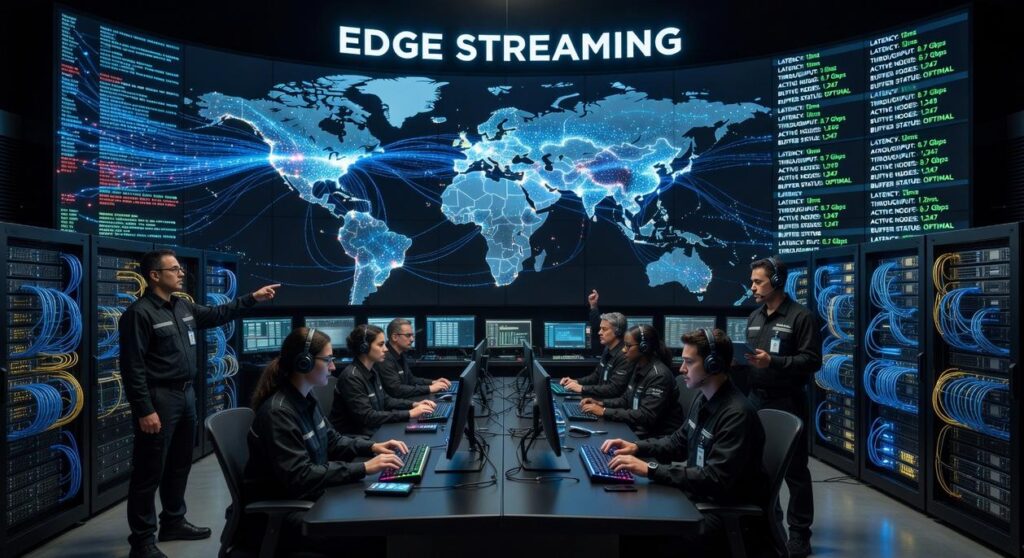

Streaming a football match from a server in Virginia while you’re sitting in Manila shouldn’t work as well as it does. There are 13,000 kilometers of undersea cable, a dozen routing hops, and at least three continents between you and that video feed. The fact that it plays at all is kind of remarkable.
Content delivery networks are the reason it works. They’ve been solving this exact problem for about 20 years now, and the engineering has gotten genuinely impressive.
Distance Still Breaks Things
Most people don’t think about this, but the speed of light actually creates problems for streaming. Light through fiber moves at around 200,000 km/s. Sounds plenty fast, right? But a round trip from Tokyo to New York burns 70 milliseconds on physics alone. Add TCP handshakes, routing overhead, and some congestion during peak hours, and you’re over 150ms before your player receives a single frame.
CDNs deal with this the obvious way: they copy content onto servers that are physically closer to viewers. Akamai has around 4,100 points of presence in 135 countries. Cloudflare, CloudFront, Fastly, all run similar setups. Hit play in Berlin and the video comes from Frankfurt, not from some origin server on the US East Coast.
The proximity trick matters for region-locked content too. People outside Europe who want German YouTube videos, for instance, will route through a german proxy youtube setup to look like a local viewer. The CDN then picks the closest European edge node to serve the stream. When the proxy is near a decent PoP, it actually works surprisingly well.
Adaptive Bitrate Does the Heavy Lifting
Getting the video close to the viewer is step one. Step two is making sure it plays without buffering even when bandwidth fluctuates, which it always does.
That’s where ABR protocols like HLS and DASH come in. They chop video into small chunks (2 to 10 seconds each) and encode every chunk at multiple quality levels. Your player monitors bandwidth constantly. Drop from 25 Mbps to 8? It switches from 4K to 1080p mid-stream, no pause, no spinner. The edge server already has every tier cached, so the swap is near-instant.
Netflix took this concept to an extreme. They put Open Connect boxes directly inside ISP networks, which means over 90% of their traffic in some countries never hits the open internet. It’s an expensive approach, but when you’re serving 260 million subscribers, it pays off fast.
Live Events Are the Real Test
On-demand content is relatively forgiving. Cache it once, serve it a million times. Live events are a totally different animal. Tens of millions of concurrent viewers, all starting at the exact same moment, creating a near-vertical traffic spike.
CDN operators plan for this weeks in advance. They look at historical viewership data, pre-position capacity at regional PoPs, and spin up extra servers before kickoff. Cloudflare’s technical overview describes how anycast routing sends each viewer request to the nearest healthy node. One location gets overloaded? Traffic slides to the next one automatically. The viewer has no idea.
There’s a massive gap between regions though. South Korea averages around 200 Mbps on broadband. Parts of Nigeria and Ghana get maybe 5 to 15 Mbps. CDN providers run much heavier compression for those markets and have been building out more PoPs in sub-Saharan Africa and Southeast Asia to close the distance gap.
The QUIC Protocol Changed More Than People Realize
HTTP/3 (which runs on Google’s QUIC) quietly rewired how video chunks travel from edge servers to your screen. Old-school HTTP/1.1 opened a separate TCP connection for each request. It was slow and wasteful. QUIC uses UDP with multiplexing baked in, so connection setup drops from three round trips to just one.
YouTube saw rebuffering fall by 30% after switching to QUIC. The IETF published RFC 9000 specifically to standardize QUIC for these high-throughput, long-lived connections. One nice bonus: QUIC includes TLS 1.3 encryption by default. Every video stream is encrypted without bolting on extra protocol layers, which older setups always required.
What’s Coming Next
Edge nodes are doing more than caching now. They’re running small programs that handle DRM verification, ad insertion, and content personalization without calling home to a central server. It cuts latency for interactive features like live polls and watch parties.
5G plays into this too. Theoretical speeds above 1 Gbps with sub-10ms latency make mobile streaming almost indistinguishable from a wired connection. A few CDN operators have started putting edge servers at cell tower locations, which is about as close to the viewer as you can physically get.
Regional video delivery is becoming a real competitive moat. The providers who solve it best won’t just make streaming smoother; they’ll own the layer underneath every platform, and that’s the kind of advantage that compounds quietly.