
The gaming industry moves fast—new titles launch daily, competitive metas shift overnight, and player expectations evolve with every update. If you’re here, you’re likely looking to understand what’s really driving today’s game industry buzz, how gameplay fundamentals are changing, and where competitive and multiplayer trends are heading next.
This article breaks it all down in a clear, practical way. We’ll explore the mechanics behind engaging multiplayer systems, the strategic layers shaping modern esports scenes, and how controller optimization can directly impact performance. We’ll also examine how esports data analytics is transforming competitive play, from team strategy to player development.
Our insights are grounded in ongoing analysis of gameplay systems, competitive trends, and performance metrics across major titles and tournaments. By connecting industry developments with real gameplay mechanics, this guide helps you cut through hype and focus on what actually improves understanding, performance, and long-term engagement in today’s gaming landscape.
From Hunches to Wins: The Data-Driven Esports Revolution
“I just go with my gut,” one semi-pro player told me. His coach shot back, “Your gut doesn’t track cooldown timers.” That tension defines modern competition.
Data-driven play means replacing instinct with measurable patterns. Instead of vague feedback, you track:
- Kill/death trade ratios
- Objective control timing
- Economy efficiency per round
This is where esports data analytics changes everything. According to Newzoo, over 70% of top teams now rely on performance metrics to refine strategy.
Some argue numbers “kill creativity.” Fair. But structure fuels smarter risks (think Moneyball, but with headsets). Track, test, tweak—and win more.
Identifying Your Key Performance Indicators (KPIs)
Most players grow up obsessing over K/D/A (Kills/Deaths/Assists). It’s simple, visible, and easy to brag about. But it rarely tells the full story. A Key Performance Indicator (KPI) is a measurable value that shows how effectively a player contributes to winning—not just surviving.
Take Damage Per Minute (DPM), which tracks sustained output over time. A player with high DPM consistently pressures opponents, even without securing kills. Crowd Control Score measures how long you impair enemies with stuns, slows, or silences—often the hidden backbone of a teamfight win. And Objective Control Time tracks how long you contest or secure map objectives. (Winning the fight is great. Winning the dragon is better.)
Positional data adds another layer. Heatmaps—visual representations of where players spend most of their time—highlight risky overextensions or smart rotations. If a support’s heatmap glows in solo lanes, that may explain repeated ambushes. Understanding common engagement zones clarifies why fights break out, not just who wins them.
Economic analysis sounds intimidating, but it simply tracks resource flow. In MOBAs, gold advantages predict item-based power spikes. In tactical shooters, buy-round efficiency determines whether a team peaks with rifles or scrapes by with pistols. Would you push aggressively knowing the enemy just hit a full-buy spike?
Team-specific metrics dig deeper: cooldown tracking (timers on ability reuse), ultimate synchronization, and composition-based win rates. This is where esports data analytics becomes powerful—translating chaos into patterns.
Choosing KPIs depends on genre. FPS titles emphasize accuracy and economy. MOBAs reward objective control. Battle Royales value positioning and survival time. Pick metrics that reflect winning conditions, not just highlight reels.
The Modern Analyst’s Toolkit for Esports
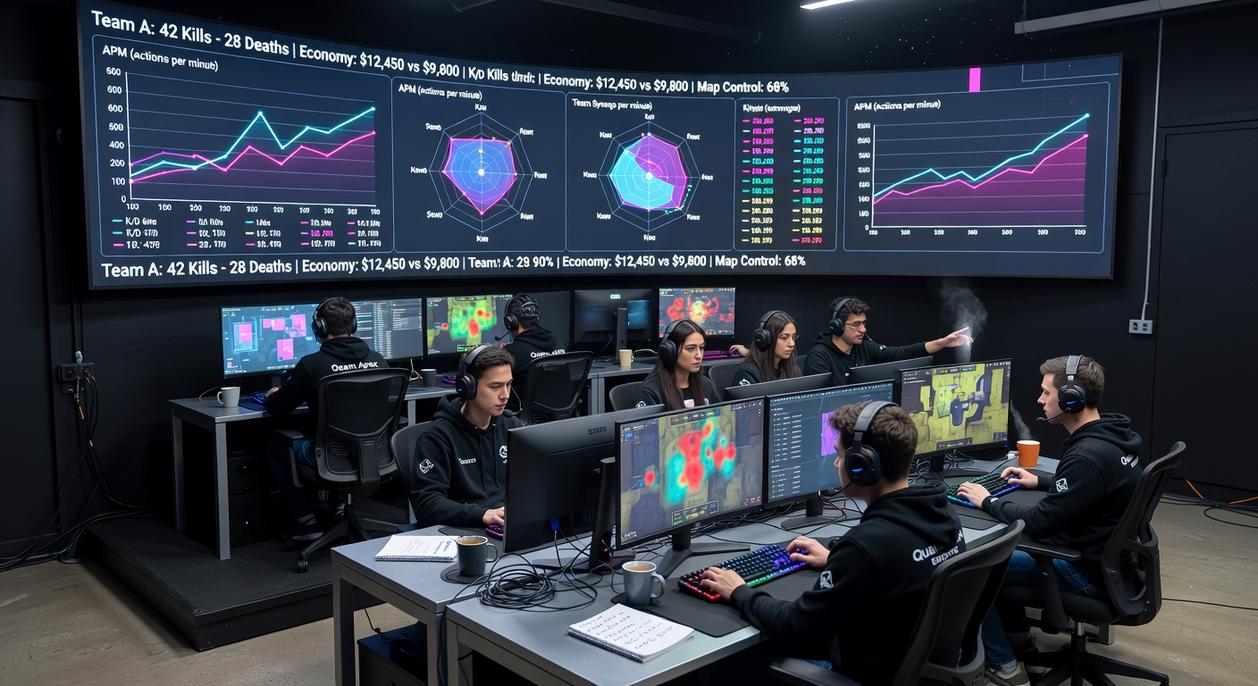
In today’s competitive scene, raw intuition isn’t enough. Analysts rely on a layered toolkit that turns gameplay into actionable insight.
Replay Analysis Software
First, built-in replay systems in titles like Dota 2 and League of Legends allow frame-by-frame breakdowns of team fights, ward placement, and gold swings. A replay system is an in-game feature that records matches for later review. Meanwhile, third-party platforms such as Mobalytics and Valorbuff add performance grading, matchup stats, and personalized trend reports. Some argue that replays alone are sufficient. However, external tools surface patterns—like declining early-game CS averages—that manual review can miss (especially after your fifth VOD of the day).
Data Aggregation Platforms
Next, APIs from services like GRID Esports and PandaScore collect structured match data at scale. An API (Application Programming Interface) allows software to communicate and share data automatically. With these feeds, analysts can compare regional drafts or track objective control percentages across entire splits. While skeptics claim this level of esports data analytics overcomplicates strategy, aggregated data often reveals meta shifts before they’re obvious on broadcast.
Spreadsheet Mastery
Of course, not every team needs advanced infrastructure. Google Sheets or Excel can track KPIs (Key Performance Indicators) like kill participation or vision score. Pivot tables summarize large datasets instantly, while line charts show improvement over time. Pro tip: lock your raw data sheet to avoid accidental edits.
Visualization Tools
Finally, tools like Datawrapper and Flourish transform numbers into digestible heatmaps and performance charts. Clear visuals accelerate review sessions and support adapting to meta shifts in fast paced competitive games (because a picture really does save twenty minutes of debate).
Case Study: Turning Data into Strategy
Everyone says “trust your instincts.” And sure, instincts matter. But when instincts contradict hard numbers, that’s where most teams quietly sabotage themselves.
Let’s start with an FPS example like VALORANT. Suppose your team’s entry-frag success rate on A-site is 20% lower than on B-site. The common counterargument? “We just need better aim on A.” It sounds reasonable. Mechanics win fights, right?
Not necessarily.
If the data consistently shows stronger trades, cleaner executes, and higher post-plant conversion on B-site, the smarter adjustment isn’t grinding aim for 40 hours. It’s restructuring defaults to prioritize B-site control. That doesn’t mean abandoning A entirely (predictability is punishable). It means reallocating utility, timing, and your strongest duelist to where the numbers already favor you.
Now shift to a MOBA like League of Legends. Data reveals a 70% mid-lane gank success rate immediately after first jungle clear. Some players argue rigid pathing makes you readable. Fair. But here’s the twist: predictability only hurts if the opponent can punish it. If early vision control and tempo deny that punishment, mandating this path as a default builds consistent early leads. In a snowball-heavy meta, consistency beats creativity.
Finally, controller optimization. Imagine discovering a 15% accuracy drop in long-range engagements. The usual reaction? “I’m just bad at range.” That’s lazy analysis. Input data might show overly high horizontal sensitivity causing micro-corrections to overshoot. The adjustment: lower sensitivity slightly and run focused long-range tracking drills (yes, boring ones). Pro tip: change settings incrementally—dramatic shifts wreck muscle memory.
Across all three cases, esports data analytics isn’t about replacing intuition. It’s about stress-testing it.
Moneyball changed baseball because it questioned tradition. Competitive gaming is no different. If the numbers disagree with your ego, trust the numbers (even when it stings).
Your Path to Data-Informed Dominance
This article has provided a clear framework for collecting, analyzing, and applying esports data analytics to win more games.
Now, instead of intuition alone, you can choose A: gut calls in clutch moments, or B: decisions backed by tracked KPIs and match reviews. While some argue instinct is faster, data reveals patterns your reflexes miss (even Faker studies VODs). In other words, small tracked adjustments outperform vague hopes.
Start today: select one KPI, monitor five matches, compare outcomes, then implement one precise tweak. Pro tip: consistency beats intensity when building measurable dominance over time. Track, adapt, and climb smarter faster.
Level Up Your Competitive Edge
You came here to better understand how the modern game industry operates—from gameplay fundamentals to multiplayer mechanics and competitive ecosystems. Now you have a clearer view of how each piece connects and how smart players and teams gain their advantage.
The reality is this: the gap between casual participation and competitive excellence keeps widening. Without insight into performance trends, controller optimization, and esports data analytics, it’s easy to fall behind while others refine every move with precision.
If you’re serious about improving, don’t stop at theory. Start reviewing your gameplay metrics, analyze your multiplayer decision-making patterns, and apply structured optimization to your setup. Leverage trusted insights and proven competitive breakdowns to sharpen your strategy.
Thousands of competitive players rely on data-backed analysis to stay ahead of the meta. If you’re ready to eliminate guesswork, refine your mechanics, and compete smarter—not just harder—dive deeper now and start transforming your performance today.